
I handed in my notice on a Tuesday afternoon. My manager stared at me like I had just announced I was moving to the moon. I had traded a steady salary, a pension, and a reserved parking spot for 8 Sundays and a Level 3 PT Diploma in Northamptonshire. Here is my honest verdict on whether that was the smartest or most reckless thing I have ever done.
- A Level 3 PT Diploma is the minimum requirement to work as a personal trainer in the UK. Without it, you cannot get insured or book clients through any major gym.
- The qualification is regulated by OFQUAL and endorsed by CIMSPA, which means it is accepted industry-wide across every gym chain in the country.
- Self-employed PTs in the UK typically charge £30 to £60 per hour. There is no income ceiling once you build a client base.
- The first six months after qualifying are harder than the course itself. Client acquisition is a skill the diploma does not teach.
- Where you train matters as much as what you study. Practical hours with real clients during the course give you a significant edge.
- If you go in with realistic expectations and a plan, the diploma is absolutely worth it.
- The Day I Decided My Office Career Was Over
- What a Level 3 PT Diploma Actually Gets You
- How 8 Sundays Turned Me Into a Qualified PT
- What Gyms and Employers Actually Think of the Diploma
- Honest Numbers: What You Can Realistically Earn
- The Stuff Nobody Warned Me About Before I Qualified
- Was It Worth It? My Honest Verdict
- Common Questions About Getting a PT Diploma
The Day I Decided My Office Career Was Over
I was 34, sitting in a Monday morning meeting that could have been an email, when it hit me. I had spent eleven years in project management. I was good at it. I was also quietly miserable doing it.
Fitness had never been a hobby for me. It was closer to an obsession. I trained five mornings a week before work. I read everything I could find about programming, nutrition, and physiology. I gave informal advice to friends and watched them get results. I just never thought I could do it as a career.
The thing that changed my mind was straightforward. I looked at what the work actually required. A Level 3 Personal Training Diploma. A few months of study. And the willingness to start again.
"I looked at what the work actually required. A Level 3 PT Diploma. A few months of study. And the willingness to start again."
I found the Level 3 Personal Training Diploma at WEFC Academy in Towcester, Northamptonshire. It fit around a working schedule. 8 Sundays. £2,200. OFQUAL regulated and CIMSPA endorsed. I booked my place before I had time to talk myself out of it.
What a Level 3 PT Diploma Actually Gets You
Let me be direct about what the diploma is and what it is not. It is not a golden ticket. It is the entry requirement. Without it, you cannot get professional insurance. Without insurance, no gym will let you train clients on their floor. So the diploma is the foundation everything else is built on.
The Level 3 qualification is regulated by OFQUAL and endorsed by CIMSPA, the professional body for the sport and fitness industry. That matters. It means the qualification is recognised by every major gym chain in the UK. PureGym. David Lloyd. Nuffield. JD Gyms. All of them.
What the diploma teaches you is the science behind good coaching. Anatomy. Physiology. Programme design. Nutrition basics. Health screening and consultation. How to adapt training for different goals and different populations. You do not just learn how to train people. You learn why specific approaches work and how to explain that to a client.
The practical component is where courses differ. Some programmes are almost entirely online. Others, like the one at WEFC, put you in front of real clients during training. That gap in experience makes a significant difference when you are trying to land your first paying client.
How 8 Sundays Turned Me Into a Qualified PT
I will be honest. I expected the course to feel like a classroom. It did not.
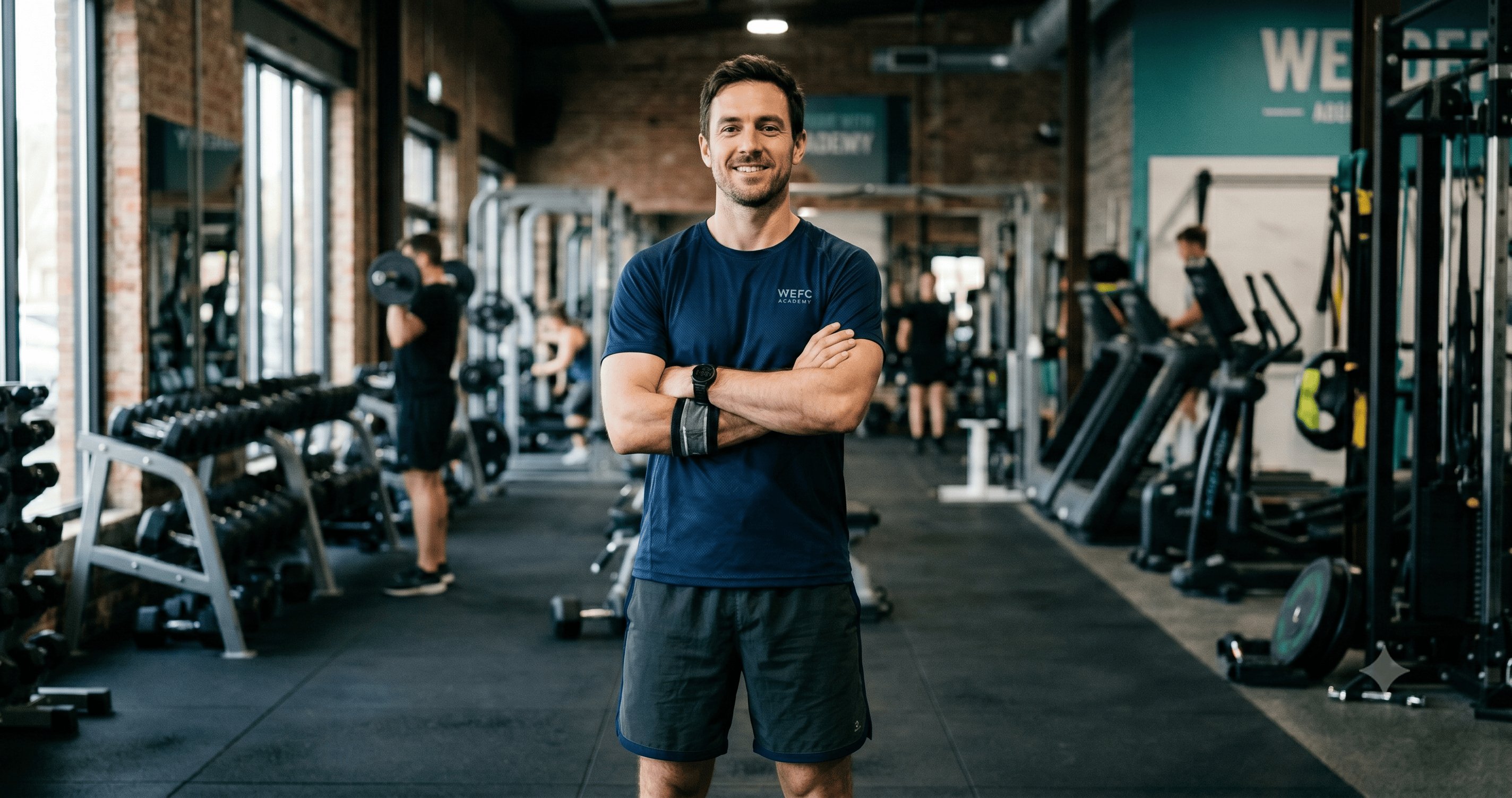
The sessions ran from 3.30pm to 8pm every other Sunday at Wellbeing Fitness in Towcester. The facility trains over 800 clients a month. You were not practising on mannequins or watching slideshows. You were on the gym floor with real equipment, working with real people, getting instant feedback from tutors who train clients themselves.
Between sessions you worked through the theory via an online student hub. It was manageable. I kept my job through the whole course. Most people in my cohort did the same. Some had children. One was running a part-time business. The Sunday structure was designed for exactly that situation.
The assessments were practical and written. They tested whether you could actually coach, not just recite definitions. I passed first time. The 98% completion rate at WEFC is not an accident. The support structure makes a difference.
Thinking about making the same switch?
The WEFC Academy quiz takes two minutes and tells you which course fits your situation. No sales call. No pressure. Just an honest answer.
Take the Free Course QuizWhat Gyms and Employers Actually Think of the Diploma
The first question most gym managers ask is not what you scored on your assessments. It is who awarded your qualification and whether it is CIMSPA endorsed.
A Focus Awards and CIMSPA endorsed Level 3 diploma, which is what WEFC delivers, passes that check immediately. You are registerable on the CIMSPA directory, which is how many gyms and clubs verify PTs before offering floor space. Employers see the logo and move on to the interview.
What they ask next is where it gets more personal. Can you generate your own clients? Do you understand how to retain them? What is your niche? These are business questions, not fitness questions. The diploma does not answer them. You have to build that layer yourself.
The advantage of training with a centre like WEFC is that you spend your course inside a working gym business. You see how client relationships are built. You watch retention in practice. That informal education runs alongside the qualification itself and it is something no online-only course can replicate.
Honest Numbers: What You Can Realistically Earn as a PT
I will not give you inflated figures. You deserve the actual numbers.
Self-employed PTs in the UK typically charge between £30 and £60 per hour. In a location like Northamptonshire, most new PTs start at £35 to £45 per session. That is not a salary. It is a rate, and your income depends entirely on how many sessions you fill.
In your first three months, expect 5 to 8 regular clients. That is £700 to £1,400 per month if you are charging £35 per session and seeing each client twice a week. It is lean. By month six, with consistent effort on referrals and visibility, most PTs I know had doubled that number.
The ceiling is genuinely uncapped. PTs who build a strong local reputation, add online coaching, or develop group programmes can move comfortably past £50,000 a year. I know PTs in the Northamptonshire area doing exactly that. But they treat it like a business, not a hobby.
One honest warning. According to industry data, 2 in every 10 PTs are still working as personal trainers after 24 months. That is not because the career is bad. It is because some people qualify and expect clients to appear. They do not. The diploma gets you to the start line. The business work begins after you cross it.
What the Pros and Cons of PT Actually Look Like
This video from a working personal trainer is one of the most honest takes I have seen on what the career actually involves day to day. Watch it before you decide. It will not put you off if this is genuinely for you. But it will make sure you go in with clear eyes.
The Stuff Nobody Warned Me About Before I Qualified
Nobody told me how isolating the first few months would be. When you are employed, there is a structure around you. As a self-employed PT, you wake up every morning and the whole day is yours to fill. That is either freedom or paralysis, depending on your mindset.
Nobody told me how much of the job is admin. Scheduling. Invoicing. Following up on enquiries. Writing programmes. Posting content. You will spend nearly as much time on business tasks as you do coaching. If that sounds exhausting, factor it into your decision.
Nobody told me that my first client would not come from a website or an Instagram page. She came from a conversation in a car park after I helped someone load their shopping. Referrals and word of mouth are still the most powerful marketing most PTs ever use.
And nobody told me how good it would feel to watch a client who came to me unable to deadlift their own bodyweight pull 100kg off the floor two months later. That part is real. The work is genuinely meaningful in a way that project management never was for me.
The next WEFC cohort starts 17th January 2027.
Places are limited and the course fills from the waiting list first. If you are serious about making the switch, the time to move is now, not when the intake is full.
See the Level 3 PT DiplomaWas the PT Diploma Worth It? My Honest Verdict
Yes. But not in the way I expected.
I thought the diploma would be the hard part. It was not. The hard part was the six months after qualifying, when I was building a client base from nothing while managing my own anxiety about whether I had made a catastrophic mistake.
What the diploma gave me was the right to practise. The OFQUAL regulated, CIMSPA endorsed qualification from WEFC meant that every door I knocked on opened. No gym questioned the credential. No client asked whether it was legitimate. That foundation mattered more than I appreciated at the time.
Two years on, I work with 22 regular clients across the week. Some are from Towcester. Some travel from Northampton and Milton Keynes. Three are online. My income is higher than it was in project management and I have not sat in a meeting that could have been an email since the day I handed in my notice.
If you are asking whether a personal training diploma in Northamptonshire is worth it, my answer is this. It is worth it if you treat the qualification as the start, not the finish. The diploma opens the door. Everything after that depends on you.
If you are on the fence, do not wait until you have thought about it for another six months. Use the free course quiz at WEFC to see which programme fits your situation. Or read more from the team on the WEFC blog. Either way, do something. A decision delayed is just a slower version of the same regret.
Common Questions About Getting a PT Diploma
-
What is a Level 3 PT Diploma and do I need one to work in the UK?
A Level 3 Personal Training Diploma is the nationally recognised minimum qualification to work as a personal trainer in the UK. It is regulated by OFQUAL and endorsed by CIMSPA. Without it, you cannot gain professional insurance or book clients through any major gym chain. It is not optional if you want to work legally and professionally.
-
How long does a Level 3 Personal Training Diploma take?
It depends on the course format. At WEFC Academy in Northamptonshire, the diploma is delivered across 8 Sundays, running from January to March. You also complete self-study work between sessions through an online student hub. Most students finish within three months while staying in their current job.
-
Is a personal training diploma worth it if I already have a degree?
Yes. A degree in an unrelated field carries no weight with gym employers or self-employed clients. The Level 3 PT Diploma is the specific credential the fitness industry requires. Your degree may help with business skills and client communication, but you still need the diploma to practise legally and professionally.
-
Can I do a personal training diploma in Northamptonshire?
Yes. WEFC Academy in Towcester, Northamptonshire, delivers the Level 3 Personal Training Diploma on 8 Sundays, making it accessible to people across Northampton, Wellingborough, Kettering, Corby, Milton Keynes, and the surrounding area. You do not need to travel to a city to get a nationally recognised qualification.
-
What do gyms look for beyond a PT diploma?
Gyms want PTs who can sell sessions and retain clients, not just deliver good workouts. Practical experience, real client hours during training, and a professional manner matter as much as the qualification itself. Choosing a course that includes live client practice gives you a significant advantage over people who only studied online.